By Leah Gross-Harmon
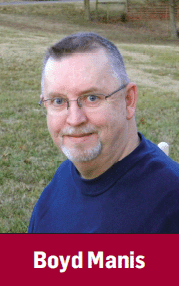
The 12th leading cause of death by disease, cirrhosis is a condition in which the liver slowly deteriorates and malfunctions due to chronic injury. It is typically the result of heavy alcohol consumption and/or chronic hepatitis C. But that wasn’t the case for Boyd Manis.
A 57-year-old quality control manager for
Shaw Industries, Manis began experiencing heart problems in 2005 and was quickly diagnosed with atrial fibrillation—a condition that caused his heart to beat up to 200 times per minute. He tried every medication on the market, but only the last one proved beneficial.
In February 2008, he underwent cardioversion surgery to correct his heart problem. Just when he thought his health concerns were over, doctors discovered the medication he’d been taking for his heart had resulted in cirrhosis. His only chance for survival was a liver transplant.
In a procedure called paracentesis, Manis had up to 24 liters of fluid removed from his abdominal cavity on multiple occasions. After two weeks at Emory University Hospital in Atlanta, he was discharged to begin the transplant waiting game, which was expected to be longer than normal due to his rare blood type.
Manis and his family researched survival rates at nearby hospitals and chose to return to Emory for the transplant. The only problem was that Manis’ health insurance refused to pay for the surgery at Emory. For reasons understood only by the insurer, the company would only pay for a transplant at the University of Alabama or at Piedmont Hospital in Atlanta.
Apprehensive, Manis was admitted to Piedmont’s Transplant Unit in June 2008 with excruciating stomach pain and the return of fluid accumulation in his abdomen, which caused shortness of breath, ankle swelling, memory loss and the inability to walk or talk.
He stayed at Piedmont for over a month until he was sent home with a wheelchair, a walker, a bedside toilet and countless medications, which he believed only made him feel worse. Thankfully, just one day after returning home, Manis received the call—a liver had been located.
At 7 a.m. on Sunday, July 20, 2009, Manis received his new liver at Piedmont. But once again, a solution was fraught with a whole new list of problems. Steroids created delirium and hallucinations. Bowels got blocked. A bile duct tore. Blood clots developed and, finally, congestive heart failure was diagnosed.
Manis endured emergency surgery, ventilators and vacuum suction in an abdominal wound shaped like a Mercedes-Benz logo and surrounded by 80 staples on the outside and hundreds of sutures on the inside.
Atlanta is an 80-mile drive from the Manis family home in Chatsworth, Ga. During his recovery period, Manis had to travel to the city two to three times each week for blood work and check-ups. His wife couldn’t work because she was needed to drive, spend nights with him in the hospital and assist her husband with practically everything when the toxicity of the ammonia in his body rendered him incoherent.
Manis racked up bills of $5,000 a month in prescription medications as well as two anti-rejection medications that cost over $2,000 a month. If he missed just one pill, there was an 80% chance his body would reject his new liver.
When his immune system went down, he required injections similar to those given to chemotherapy patients. These injections cost nearly $3,000 apiece.
In addition to these costs, Manis learned he owed a significant percentage of his $300,000 transplant bill. Needless to say, his family’s home, car and way of life was in jeopardy. Their savings account was empty.
A human resources representative and case manager at his insurance company informed Manis about the
Floor Covering Industry Foundation (FCIF). Founded in 1980 by several prominent industry figures, led by the late Walter Guinan, FCIF is dedicated to financially assisting floor covering industry professionals who experience catastrophic illness, severe disabilities or other life-altering hardships.
Manis applied to the Foundation by submitting a simple history of his situation, as well as providing details of his current financial situation. Within a matter of weeks, he received a phone call that changed his life.
FCIF awarded Manis money to cover his medications, house payments and car payments for six months. But more importantly, the foundation gave him and his family peace of mind.
“Without the assistance of the FCIF, I would not have been able to survive financially,” he said. “With the organization’s assistance, I knew I wasn’t going to lose my home or my car and that I could afford the medications that my life depended on.”
FCIF treats all grant recipients confidentially. The only reason Manis’ story is being told here is because he chose to go public. He hopes to show his appreciation to the organization and give it a human face so others may be aware of its extraordinary efforts.
“It is so nice to know that there are people who still care even though I am a complete stranger to them,” Manis said. “My dedication to the floor covering industry paid off when I needed it the most.”
Manis, who has been working in the flooring industry for nearly 40 years, is back at his job for Shaw, where he has worked for the past 14 years.
Since it’s founding, FCIF has granted more than $1.5 million to help those in need. Beneficiaries include retailers, installers, retail salespeople, distributor personnel, mill employees and executives. The foundation ensures these philanthropic efforts are accomplished with compassion, confidentiality and preservation of dignity for the individuals concerned. Financial help is viewed as an opportunity to say, “we care” to those in our industry.
For more on the Floor Covering Industry Foundation or to help members of our industry family such as Boyd Manis cope with life-altering hardships, please visit fcif.org.