By Louis Iannaco
ST. LOUIS—Two U.S.-based wood flooring producers have begun the audit process to become certified under the
National Wood Flooring Association’s (
NWFA) Responsible Procurement Program for Hardwood (RPPH).
Anderson Hardwood Floors and Mullican Flooring are currently participating in a pilot program to test the audit phase of the RPPH.
The audits are being conducted by Scientific Certification Systems (SCS), a third-party provider of certification, auditing and testing services. SCS will work with the two mills to design, develop and test the audit process for NWFA’s new program.
NWFA established the RPPH program to recognize wood flooring companies that work to sustain the world’s forests. The program is supported by the Forest Stewardship Council (FSC)-U.S. and FSC Family Forests Alliance, and is based on three tiers of increasing voluntary participation/associated certification.
According to
Ed Korczak, NWFA’s executive director, RPPH works two-fold. “It audits and validates manufacturers that utilize hardwood from renewably managed forests through third-party verification— SCS—offering a three-tier system of certification.”
The program impacts the hardwood flooring industry in several ways, he noted:
• It recognizes the industry as being environmentally responsible.
• It encourages all manufacturers to source their raw materials from responsibly managed forests.
• It helps to protect the raw materials that provide for the industry’s way of life by discouraging illegal logging.
• It supports fair global trade by helping to reduce the amount of low-cost, often inferior, illegal material from entering the marketplace.
• It helps to eliminate global warming, which, in turn, helps preserve the environment for future generations.
• It recognizes those companies that practice responsible forestry.
Tier 1 requires mills to participate in the NWFA Verified Renewing Forests program—meaning members purchase a certain percentage of wood from one or more of the renewably managed forests across 33 states—and, in return, are able to utilize the NWFA Verified Sourced From U.S. Renewing Forests label on hardwood products. It also requires participation in the NWFA Verified Legal Origin program for imported products from high-risk countries—which verifies proper documentation on the sustainability of foreign hardwood forests used for imports— enabling mills to display the NWFA Verified Legal Imported label.
Tier 2, which members are asked to attain within three years, takes things a step further by requiring FSC chain-of-custody certification and a commitment to building trade in FSC-certified wood products. It also requires participants to meet FSC Controlled Wood standards for all non-FSC certified supply within two years.
Tier 3 is the highest level of achievement in the program, recognizing companies whose trade in FSC-certified products exceeds 50% of overall sales and whose non-FSC sales meet FSC Controlled Wood standards.
Though a suggested timeline is in place to help progress mills through the three-tier system, Korczak said as long as each participant is making a good-faith effort, it will maintain its place in the program and be promoted accordingly.
On the other hand, RPPH also encourages and rewards smaller, privately owned forests to become certified as renewably managed through the FSC Family Forests Alliance to maintain and increase available certified hardwood sites to service the growth in mill interest. The program plans to offer such incentives as small group harvesting plans to entice landowners to join.
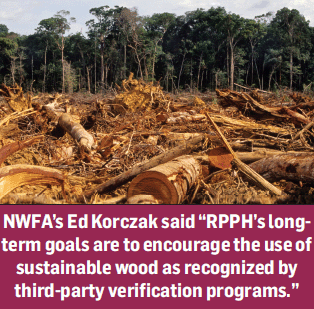
“RPPH’s long-term goals are to encourage the use of sustainable wood as recognized by third-party verification programs,” Korczak added, “and to increase the amount of FSC-certified wood available in the U.S. NWFA recognizes that FSC certification offers the highest standard of environmental and social performance in the forest products industry, but currently, there isn’t enough FSC-certified wood available to meet demand. RPPH will recognize companies that use sustainable resources from responsibly managed forests, as well as those using FSC-certified wood.”
Anderson president
Don Finkell believes the program moves the hardwood flooring industry toward better forest management. “Having been personally involved with putting it together, somebody has to go first, and I believe in putting your money where your mouth is. We want to try to make the program credible, legitimate and to be as easy as possible for mills to do. That’s why we’re going first and, hopefully, others will have an easier time after we work through the bugs.
The program moves the industry toward better forest management and closer to FSC certification, which is the highest level of certification in the hardwood industry, he added. “It aligns the hardwood flooring industry with environmental groups, which I believe is a positive because so much of the industry around the world does not line up positively with environmental groups and are not environmentally correct. In my mind, it’s a way for the U.S., industry and NWFA members to differentiate themselves from their competitors who maybe aren’t doing as good a job.”
Neil Poland, president of Mullican, said the mill is committed to taking a leadership position in promoting the responsible harvesting of hardwood timber within the industry. “We’re participating in the pilot program for solid wood flooring of the NWFA RPPH because we believe it’s the best third-party procurement program for large-volume solid wood mills of domestic species. Mullican was the first domestic mill to offer 100% PURE FSC product on a national basis (
FCNews, Aug. 3/10) and we felt it important to take a leadership role with RPPH as well. We recognize the need for consumer assurance of a product made with care and concern for the environment. RPPH helps provide this assurance by introducing a new label into the market and information into the hands of the consumer.”
Poland said RPPH confirms what most manufacturers have known for years: “That U.S. hardwood forests are sustainable. This program, along with the NWFA Life Cycle Analysis, will help the hardwood industry become known for what it truly is: a naturally renewable product and one that will be a top choice of environmentally conscious consumers.”
For more about NWFA’s Responsible Procurement Program for Hardwood, call 800.422.4556.