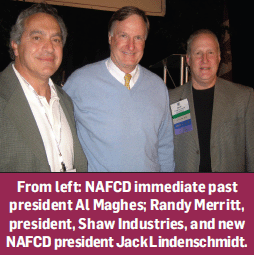
By Steven Feldman
SCHAUMBERG, ILL.—The North American Association of Floor Covering Distributors (NAFCD) may not be able to do anything about the economic climate, but it can provide its wholesaler members with some tools to remain competitive until the downturn subsides, which, according to economist Alan Beaulieu, owner of Industry Trends Research, will not occur until at least the second quarter 2010.
“Our focus is on helping the distributor channel stay strong or get stronger,” explained Moe Desmarais, executive vice president, NAFCD. To that end, the group has identified four pillars on which it will concentrate: education, leadership, networking and trends.
As an example of its educational offering, the NAFCD built the recent annual conference and Distributor Marketplace around its Fall University, an educational forum for middle managers. “The content is typically sales management, but it could be freight and logistics oriented or it could be financial,” said Jack Lindenschmidt, director of product management, ISC Surfaces, St. Louis, and incoming NAFCD president. “All but a few of the university attendees stayed on for the conference. That was our hope.”
Attaching the Fall University to the conference was applauded by distributors. “We just sent five of our managers to the university, and the early feedback was that it was mind opening and challenged them to rethink the way they are doing things,” said
Bob Weiss, president,
All-Tile, Elk Grove Village, Ill. “We can try to teach them on our own, but if we can use experts at subsidized pricing, that’s definitely the way to go. This is important because during economic downturns, our people have to be better and smarter.”
A big part of the educational initiative is leadership training, which is achieved in various ways. For starters, NAFCD is part of the Association Education Alliance (AEA), a group of 35 distribution associations, primarily in construction trades. The alliance hosts four major programs every year at Purdue University called the University of Industrial Distribution. Between 500 and 600 distributors attend each four-day event and choose from 40 management courses that delve into sales, warehousing, freight, logistics, financial and more. “About 20 to 30 NAFCD members attend these programs,” Desmarais said. “And there is also a certification program that goes with it.”
In addition, every summer AEA hosts a Future Leaders Conference in Chicago that is entirely focused on the management of a distribution company, Desmarais said, adding that each two-day event includes many networking sessions. “It is geared toward those moving up within a company, those on a track to be a vice president, CFO, branch manager, etc.”
Networking is a major pillar in the NAFCD offering. In illustration, at last month’s conference the group set aside a couple of hours for members to break out in small groups, each facilitated by a board member. Among the topics discussed were sales motivation, compensation, transportation costs, passing costs on to the customer, expense recovery, etc. The facilitators took notes and NAFCD will soon create a report based on the discussions.
In addition, distributor members have been asked to supply NAFCD with the names of employees in specific departments. The association will enter these names in its own data base, link them together and provide the list to members. The idea is for people in like departments, freight and shipping for example, to network with each other.
“It’s all about strength by association,” All-Tile’s Weiss said. “During the breaks you get to talk to people, you get to know them over the years and share best practices. You get to meet people you don’t get to play with on a daily basis and share thoughts.”
Jeff Striegel, president of
Elias Wilf in Owing Mills, Md., agreed, adding, “I think it’s good to get outside your box and be exposed to a combination of seminars and peers.”
NAFCD is also doing its part to keep its members up to date on the latest trends—design and otherwise.
Desmarais told
FCNews the NAFCD hired a colorist, Denise Turner, who presented at the conference and will be following up with a report. “The focus is really on the trends from the consumer as well as from the retailer, and how you prepare for that in your inventory and buying process.”
Turner will also pen a column in the association’s newsletter, reporting on trends as they change throughout the year. “There is also the possibility of a Webinar if there is significant interest on the part of members.”
NAFCD is also in discussions with Industry Trends Research’s Beaulieu to develop an economic trends forecast on a quarterly basis. This will be followed by a Webinar to explain how to use this report in members’ businesses.
The conventionNAFCD’s 37th annual conference represented a format change from years past, both in locale and focus. According to Lindenschmidt, the conference has traditionally focused on top-tier management—owners, CEOs and presidents—at a resort setting. But he noted that members value education and wanted to get their middle managers involved in the organization and training opportunities it offers.
To that end, NAFCD held this event at a less costly, more convenient location and made it more of an educational event for middle managers (Fall University). “The intent was to put more meat on the bone,” Lindenschmidt said.
Elias Wilf’s Striegel, for one, is a fan of the format. “I’m here for business, not a vacation. When the event was at a resort, and people took their significant others, they often felt obligated to sit out by the pool. This format is more productive for the people who want to do business.”
And Jonathan Train, product manager,
Swiff Train Co., and former NAFCD board member, noted, “In some ways I’d like to send more of my people here, but on a lower cost basis. Mostly, this deal has been for the executive management. To get those who will be rising in your company involved is invaluable.”
Next year NAFCD is looking to add even more value to the conference. “One thing we will do next year is schedule non-conflicting time slots for manufacturers to hold meetings with existing and prospective distributors, where they can have time away from the marketplace in a more private setting,” Lindenschmidt said. “We will have dedicated rooms so they can reserve blocks of time. The big change is that it will not be conflictive of any NAFCD sessions.”
Looking two years down the road, NAFCD is exploring the possibility of sharing its 2010 convention with the North American Building Materials Distributors Association (NBMDA) based out of Colorado Springs, Colo.
“It’s called co-location,” Desmarais said. “There are economies of scale in bringing similar groups together to share speakers, expenses and a location. It gives us greater buyer power with the hotel and speakers.”
Lindenschmidt noted that the question is whether NAFCD can add value and still maintain its own persona. “We think there is great value there. We know the location can accommodate both groups. The fear is that we lose some of our own insignia if we blend with someone else.”
As for the logistics, Desmarais said the two trade fairs— NAFCD’s Distributor Marketplace and NBMDA’s conference booth program—would be held simultaneously in adjacent ballrooms. Any member from either group could visit either trade show. Some of the general sessions would overlap. Then the next day NAFCD would hold its breakout sessions. “This way neither association loses its identity,” he said.
While some distributors with whom FCNews spoke endorsed the idea, Elias Wilf’s Striegel has his reservations. “The two associations have completely different sales formats, the product nuances are different, how they go to market is completely different,” he said. “But I’d be more concerned that flooring manufacturers would be exposed to new distributors. What if some saw the value of picking up a building materials distributor vs. a flooring distributor, like the
CCA Global deal with BlueLinx?”
Swiff-Train’s Train is also happy with the status quo. “Personally, I think the organization does a good job of filling its mission. Even though the convention is smaller, it’s still worthwhile. I think partnering with another association may dilute it.”
Train added that he is not necessarily concerned about manufacturers using distributors from another industry. “Everyday you have to justify your value to your customers and suppliers.”
All these initiatives are geared toward increasing attendance at the annual conference. The group is comprised of about 220 members, divided almost equally between manufacturers and distributors.
According to Desmarais, this year 58% of distributor members and 75% of manufacturers were on hand. “This is pretty much the same as last year; there was a bit of a reduction on the manufacturer side due to budget limitations, and mergers and consolidations.”
Lindenschmidt added that NAFCD is seeking to increase membership in general. “This year we are going to review the criteria for manufacturer and distributor membership. For example, we don’t accept distributor members that are office only—they must have warehouse. A member must also be recognized by the retail community as a wholesaler in the market. Thus, an Internet-only business would not qualify.”
Distributor MarketplaceFor the third consecutive year, NAFCD hosted its Distributor Marketplace, which serves as an arena for suppliers to either fill geographic holes in their distribution or for newer companies to establish distribution.
Rob Tarver, vice president of sales and marketing, Avaire, told FCNews he came away with eight solid leads. And Frank Hearst, vice president of sales, Dansk Hardwood, cemented a deal with a distributor on the show floor.
Some exhibitors used the marketplace to solidify agreements to supply distributors with private label lines. For example, Struxtur, makers of the Hewn line, solidified deals to private label hardwood for four distributors.
This year, however, many wholesalers were not looking to take on new lines. Striegel noted, “The reality is the way business is right now, the question is how can you do more with what you have rather than pick up more lines. It’s not fair to our existing suppliers to take on new lines in this environment.”