 |
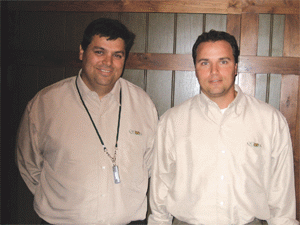
| QFloors owners Chad, left, and Trent Ogden. |
|
By Steven Feldman
Park City, Utah—When it comes to maximizing profit opportunities, floor covering retailers will accept any edge they can get. That would explain why more and more dealers are embracing
QFloors software as a means to not only organize their businesses, but increase their bottom line.
At the company’s annual users conference here Sept. 27-29, a growing number of QFloors’ 400 customers were quick to extol the program’s virtues. They all agreed the software’s ease of use, coupled with its real-time data capabilities, have positively impacted their businesses.
Barb Clements, co-owner of Al’s Carpet in Rockford, Ill., with her husband, Al, and daughter, Erica, is a case in point. “If it wasn’t for QFloors, I’d be out of business,” she said. “Until we started using the program we had no idea where we were making money, losing money and spending money.”
Business at Al’s Carpet is up 30% this year, but more important, profit margins have increased between 5% and 10%. “We instantly know our exact margin when we quote jobs now,” Clements said. “So we know on the spot the lowest price we can offer a customer to make an acceptable margin.”
Steve Wilson, owner of Sonora Flooring Center in Sonora, Calif., agreed. “Sales may be off between 15% and 18% this year, but profitability is only off 3%. We have seen where our expenses may be a little high and can make cuts.”
Wilson also credited the program for helping him set and maintain margins. “Salespeople used to ask if there was a better price we could give the customer. Now they go into the program and know the lowest price. We can set different pricing levels or margins internally.”
Retailers were also touting the simplicity of the program. Al’s Carpet’s Erica Clements serves as the optimal case study. “I learned the program in a matter of days.” Clements, 23, went to work for the family business upon graduating college. Within a week her parents were called out of town. “I sold a $10,000 job because all I had to do was use the program. I was basically on auto pilot.”
Wilson also cited QFloors’ ease of use as a major selling point. He noted how QFloors can break down profit and loss, look at month-to-dates and year-to-dates along with profit margins or individual jobs with one click of a button.
Lois Traxler, co-owner of Best Buy Carpet in Nicville, Fla., with her husband, Emmett, concurred. “We are not computer whizes,” she said. “QFloors is simple to operate. It’s the closest thing I ever bought to plug and play.”
Most QFloors customers have previously utilized some type of computer software to run their businesses, whether floor covering-specific from another vendor or a generic off-the-shelf system like QuickBooks. The primary functions of such systems include the necessities: accounts payables, accounts receivable, payroll, inventory control and invoicing. However, according to Trent Ogden, CFO of QFloors, approximately 25% of new customers were not employing technology of any kind short of a fax machine. And that’s a mistake, he said, citing five advantages of using automation:
1. It reduces errors.
2. It allows people to manage more volume with the same amount of people, which means increased profitability.
3. Fewer mistakes means an owner is capable of leaving the business more often because he doesn’t have to watch what’s going on every second of the day. “Because of QFloors,” said Best Buy Carpet’s Emmett Traxler, “I’ve been able to stay away from the store more often and spend time with the grandkids.”
4. It provides real-time numbers, which allows an owner to make decisions about his business based on what’s happening today versus last year. “It used to be reps would come in with a special and you’d fly by the seat of your pants, hoping the money would be there when the invoice came due,” Sonora Flooring’s Wilson said. “Now we have a better feel as to whether we can make that purchase. We can look immediately at receivables and our current financial status.”
5. It makes the business sellable. “It’s not worth anything without technology,” said Chad Ogden, president and CEO, QFloors.
About 25% of QFloors customers had been using another floor covering-specific software system. “Retailers have told us they were using only parts of other programs because some components were too difficult,” Trent Ogden said. Others cite a time savings. “We’ve been told our program takes 40% fewer clicks and keystrokes to do the same amount of work.”
But the bulk of QFloors users switched from Quick-Books or another off-the-shelf system. They quickly learned its limitations. “QuickBooks is a good system for item-in, item-out businesses,” Chad Ogden said. “But floor covering is not that kind of business.” When a retailer receives a $5,000 cash deposit, QuickBooks recognizes that as income. In the QFloors system, that $5,000 is not recognized until the job is completed. “It misreports income” which means their tax is off. “It doesn’t account for the sales at the right time.”
Chad Ogden noted another flaw. “QuickBooks will never have the ability to do B2B transactions. And B2B will only become more significant in the future. That alone will soon make QuickBooks obsolete for the midsized dealer.”
Differentiators
What sets QFloors apart from the competition? According to Chad and Trent Ogden, a lot. In illustration:
1. Ease of use: “You don’t have to open up as many screens to do the same amount of work,” Trent Odgen said. “For example, with QFloors you can do all the data entry on one screen; other programs you need to click in to one screen to enter customer name, another to enter the body of the invoice, etc.
2. Different software that fits different types of businesses. There is a version for the smaller dealer (up to $1 million), medium size dealer, large dealer and “enterprise” dealer.
3. Customer service. “We have more than 90% customer satisfaction on our service end,” Trent Ogden said, adding that users get real people when they call and unlimited support. “They don’t have to pull out their credit card every time they call us.”
4. The time expenditure to convert a business. “We can do in four days what most of our competitors take six months to do,” Trent Ogden said.
5. No charge for B2B. “Competitors charge extra for that feature,” Trent Ogden said.
6. No secrets. “We publish our prices on the Internet,” Chad Ogden said.
Many retailers have been reluctant to embrace technology because of the costs involved. But QFloors makes it affordable for any sized dealer. According to Trent Ogden, the actual cost will vary based on number of users, volume of transactions and number of locations. But the typical store, which is one location with sales ranging from $2 million to $3 million with five users on the system, will pay $8,500 for the software and $3,500 for on-site training and conversion. Ogden noted that not every program user requires on-site training.
After the initial outlay, there is an optional maintenance fee of $100 a month beginning in year two, which includes all updates and unlimited training. “More than 85% of our users continue to renew the maintenance fee,” Trent Ogden said. “The value added makes it worth it in their mind.”
Al’s Carpet’s Barb Clements may have said it best: “I don’t even think about the cost. The way I look at it, I can’t afford to run my business without QFloors.”