By Emily Hooper
Since greenwashing has become the new bad word in floor covering, companies are eager to validate their eco-friendly products and processes. While certifying people can hold certain connotations, certifying a manufacturing process or product is one of the most respected ways to prove a company’s low environmental impact, especially when it’s the first to be certified in any number of categories.
The
National Wood Flooring Association (
NWFA) announced a certification first recently when
Anderson Hardwood Floors became the pioneer company certified under the organization’s Responsible Procurement Program (RPP). With audits conducted by Scientific Certification Systems (SCS) and support from the Forest Stewardship Council (FSC) and the Family Forests Alliance, RPP outlines a three-tiered process.
The first tier is entry-level and requires compliance with a list of criteria that includes following responsible procurement policies and RPP’s chain of custody program. Participants have two years to advance to the second tier, the transitional-stage and another two years to complete those stage-specific requirements. The third tier is the final and highest level in the program, which requires all wood meet FSC standards and for 50% of all sales to be from FSC-certified wood.
“NWFA is excited to see Anderson take this strong step forward for the industry and the environment,” said
Ed Korczak, executive director and CEO of the association. “Anderson’s commitment to RPP speaks volumes about its corporate values.” He added that there are a handful of wood mills currently going through the RPP process.
Manufacturers with international divisions are aligning operations with their U.S. counterparts as well. Beaulieu Canada has received EcoLogo certification on many of its carpet tiles with the Nexterra backing system. The program, founded in 1988 by the Canadian government, is now a worldwide standard. EcoLogo uses a third party to verify scientific criteria of the lifecycle of a product and compares similar products on a relative scale to judge the goods.
Beaulieu Canada has long been committed to the green cause, said Marcel Poirier, vice president of commercial sales for Beaulieu Canada. In addition to ISO-14001 certification to ensure the company operates under the best environmental practices, it boasts the Enviro Select Program that runs its facilities on 100% renewable hydro and wind-power.
“We have provided our customers with enough data points to validate our environmental claims such as our unprecedented levels of post-consumer recycled content and our renewable energy usage,” Poirier said. “The EcoLogo certification is the latest proof.”
Interface also announced its NSF/ANSI 140 silver-level certification on its Glasbac and Glasbac RE modular carpet. The product is manufactured in the seaside region of Chon Buri, Thailand, about 50 miles from the capitol city of Bangkok but still meets U.S. standards of environmental stewardship as specified by NSF/ANSI 140, officially called the Sustainable Carpet Certification Program, and requires products and manufacturing practices be in accord with public and environmental health, energy efficiency, recycled material content and end-of-life management.
“Obtaining NSF/ANSI 140 certification for sustainable carpets helps us demonstrate our commitment to eliminate all negative impacts we have on the environment by 2020,” said Connie Hensler, director of life cycle assessment programs at Interface.
GreenGuardUSFloors is the recipient of the first ever GreenGuard for Children & Schools program, by the GreenGuard Environmental Institute (GEI), for bamboo flooring. GEI created the Children & Schools program in 2007 to recognize companies with products that meet or exceed low chemical emission requirements. Certification is a good way to create a safer, healthier indoor environment, said Marilyn Black, founder of GEI.
“The GreenGuard certification program attends to the public health component of sustainability,” she said, “and provides consumers and building professionals with an objective resource to minimize chemical exposure in their homes and buildings.”
Following the same vein, Shaw’s hardwood products were certified under the same program. In compliance with GEI requirements, Shaw’s hardwoods were screened for 10,000 VOCs and verified to meet chronic exposure levels stipulated by California, said
David Wilkerson, Shaw’s corporate director of sustainability and product stewardship.
“This achievement not only reinforces Shaw’s commitment to optimum indoor air quality (IAQ) but also ensures these hardwood styles are eligible for low emission credit under respective commercial and residential certification programs such as the U.S. Green Building Council’s Leadership in Energy and Environmental Design (LEED),” he added.
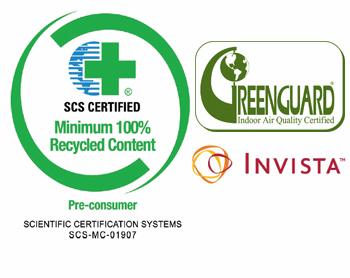
SCSMP Global’s FiberBacker underlayment is the first product for ceramic and porcelain flooring to earn Indoor Advantage Gold certification from SCS. The Indoor Advantage program ensures that product emissions comply with high IAQ standards and stands up to site audits and laboratory testing.
FiberBacker has been verified to contain 100% pre-consumer recycled content and can help with LEED certification in the materials and resources category, said Jack Boesch, MP Global’s director of marketing. It’s odorless, free of volatile organic compounds (VOCs) and is manufactured at a high-temperature that kills bacteria and fungus. There is also an EPA registered anti-microbial additive that inhibits mold growth, making it hypo-allergenic.
“Products that meet this independent rigorous and unbiased laboratory-based verification of environmental attributes can meet requirements for just about any installation where air safety and air quality are considerations,” said Stowe Hartridge-Beam, program manager, indoor air quality at SCS.
Invista, the manufacturer of
Stainmaster and
Antron carpet fibers, is also making a mark among SCS certifications as the first company to obtain the testing lab’s Environmentally Preferable Product (EPP) certification under a newly expanded standard, SCS-002. Defined under U.S. Executive Order 13423—formerly 13101—EPPs are found to have a reduced environmental affect when compared to baseline products or competitive goods that serve the same purpose.
Fibers were evaluated with advanced life cycle analysis metrics and product performance data that quantifies human health and environmental impacts across a product’s life cycle, said Stanley Rhodes, SCS president. Prior to the expansion of SCS-002, evaluation only looked at impact categories such as non-renewable energy depletion, greenhouse gas loading, oceanic and regional acidification, ground level ozone exposure and particulate matter exposure.
“Invista was awarded EPP certification after SCS’ scientific review took into account the full cradle-to-grave consequences of the raw material and energy inputs, manufacture, use, product performance, and disposal of Stainmaster and Antron carpet fibers,” he added.
“Antron carpet fibers have been certified by SCS as an EPP multiple times since 2002,” said a spokesperson for Invista’s performance surfaces and materials business. “This is the first time Stainmaster carpet fibers have been submitted for certification.”
Expanko also added its name to the roster of firsts. SCS has certified the mill’s Reztec rubber flooring to contain post industrial and post-consumer recycled content. Content amount varies from color to color, with 27% post-industrial waste in the Icicles and Marbles collections to 90% post-consumer waste in the Jet line. The rubber flooring can also help meet criteria for LEED MR 4.1 and MR 4.2.
“Reztec is the only recycled rubber flooring with this SCS certification,” said Randy Gillespie, Expanko’s vice president of marketing and sales. “Architects, designers and building owners choosing components for LEED projects prefer third party certified products such as Reztec.”
FSCTeragren, the Washington-based manufacturer of bamboo flooring, was the first company of its type to receive FSCPURE certification on its products, specifically its Traditional and Unfinished bamboo flooring. The PURE label certifies that products have been harvested in an FSC-certified forest, manufactured with FSC-certified material and are sold through an FSC chain of custody distribution system.
“Teragren has been aligned with FSC’s sustainable forestry principles since our founding in 1994,” said David Knight, president and CEO. “Our long-standing commitment to environmental, social and economic responsibility is now recognized through this worthy designation.”
Certified goods are also eligible for LEED MR credit 7 for certified wood; LEED MR 6 for rapidly renewable resources; LEED IEQ credit 4.3 for low-emitting materials—flooring systems, and LEED 4.4 low-emitting materials—composite wood and agrifiber products. Additionally, efforts are in line to certify the forests from which Teragren harvests bamboo in Anji County, China.
Similarly, Aged Woods, supplier of reclaimed and re-milled antique wood flooring, was Chain of Custody certified by FSC. The mill diverts hardwood from the deconstruction waste stream, and ultimately the landfill, and stabilizes it by a kiln-drying process, explained Jeffrey Horn, president of Aged Woods. Evaluations for the precision milled products were completed by SCS.
In addition to the chain of custody certification, the flooring can contribute to LEED points across several categories, Horn added, including the materials and resource reuse, MRc3, and the regional materials credit, MRc5. Products qualify for the latter in certain cases because the main harvesting area is within 500 miles of the corridor from Washington, D.C., to New York City and reaches to Detroit, Indianapolis, Knoxville, Tenn., and Columbia, S.C.
FSC also recognized Cikel America for its chain of custody certification, conducted by SCS. This designation assures the company’s adherence to strict environmental production practices, no small feat for a mill that sources its lumber from over one million acres of proprietary forests in Brazil.
FSC Chain of Custody certification also complies with the Lacey Act and contributes to LEED points across all of USGBC’s rating systems.
Armstrong World Industries recently gained the FSC Chain of Custody certification, for its engineered hardwood manufacturing plant in Somerset, Kan. The facility was built in the late 1980s and produces more than 500 SKUs for the Armstrong, Bruce and Capella brands, said Christopher Moore, plant manager.
HomerWood Hardwood Flooring, which is a subsidiary of Armstrong, received FSC Chain of Custody certification as well at its Titusville, Pa., plant. While FSC certification is a notable achievement, it is not the first of such for the plant. It was certified in the late ’90s by SCS before FSC certification was well recognized, said Kathleen Barker, vice president, operations.
“We recognize the importance of protecting the environment, using resources intelligently, recycling and reducing waste.” She added that while much of the wood comes from Appalachian forests, a majority of HomerWood flooring has always come from FSC-certified vendors.
Wilsonart also garnered the recognition of FSC as the first certified high pressure laminate (HPL) manufacturer in North America. With a majority of the mill’s laminate business in the commercial sector, Wilsonart recognizes the importance of producing flooring that contributes to LEED qualifications, said Rajesh Ramamurthy, director of sustainability.
This particular certification, he explained, can contribute to LEED certified project points under the program’s MR Credit 7: Certified Wood, and MR 4: Recycled Content.